Showing posts with label MySQL Cluster. Show all posts

Monday, May 27, 2024

875X improvement from RonDB 21.04.17 to 22.10.4

At Hopsworks we are working on ensuring that the online feature store will be able to perform complex join operations in real-time. This means that queries that could use data from multiple tables can be easily integrated into machine learning applications.

Today most feature stores use key-value stores like Redis and DynamoDB. These systems have no capability to issue complex join queries, if this is required the feature store will have to write complex code to handle this and this is likely to involve multiple roundtrips and thus cause unwanted latency.

Hopsworks feature store uses RonDB as its online feature store. RonDB can handle any SQL operations that MySQL can handle. Actually RonDB has even support for parallelising the join queries and pushing the filtering and joining down to the RonDB data nodes where data resides.

This means that users of the Hopsworks feature store can integrate more features from multiple feature groups in online inferencing requests. This means that things credit fraud detection can be made much more intelligent by taking more features into account in the inferencing requests.

This means that performance of real-time join queries becomes more important in RonDB. To evaluate how RonDB develops in this are I ran a set of tests using TPC-H queries from DBT3 against RonDB 21.04.17 and RonDB 22.10.4 (not released yet). I also ran tests against MySQL 8.0.35 (RonDB 22.10.4 is based on MySQL 8.0.35 with loads of added RonDB features).

The results were interesting, the improvement in Q20 was the highest I have seen in my career. The performance improved from 70 seconds to 80 milliseconds, thus an 875x speedup or 87500% improvement. Q2 had a 360x improvement. So RonDB 22.10.4 is much better equipped for more complex queries compared to RonDB 21.04. MySQL 8.0.35 had similar performance to RonDB 22.10.4 with an average of around 20% slower, this is mostly due to performance improvements in RonDB, not algorithmic changes.

When using complex queries the query optimiser tries to find an optimal plan, sometimes however better plans are available and one can add hints in the SQL query to ensure a better plan is used.

The RonDB team isn't satisfied with this however, we have realised that evaluating aggregation is also very important when the online feature store stores a time window of certain features. This means that RonDB can compute aggregate dynamically and thus provide more accurate predictions.

Early tests of some simple single table queries showed an improvement of 4-5x and we expect we will be able to get to 10-20x improvements in quite a few queries of this sort.

Friday, March 22, 2024

New LTS version of RonDB, RonDB 22.10.2

 After a very thorough development and test period we are proud to announce the general availability of the RonDB 22.10 LTS serie with the release of RonDB 22.10.2 today. There is also a new version of the old LTS version RonDB 21.04.16 released today.

A complete list of the new features is provided in the RonDB Documentation.

The most important new feature is the support of variable sized disk rows. This means a very significant saving of disk space, up to 10x more data can be stored on the same disk space as with RonDB 21.04. In addition RonDB 22.10 contains a major quality improvement using disk columns. This means that RonDB is now prepared for the introduction of features in the Hopsworks Feature Store using disk columns. This will provide significant cost savings in storing lots of features in the Hopsworks Online Feature Store.

Another important feature in RonDB 22.10 is that all major data structures are now using the Global Data Manager, this ensures that the memory management inside RonDB is much more flexible. This was the final step of a long project described here.

As usual we have also been working on performance in this new version. Write throughput has been siginficantly improved, enterprise applications using read locks will see greater scalability and also throughput at very high load has been significantly improved leading to up to 30% better throughput in RonDB 22.10.2 compared to RonDB 21.04. This improvement comes from further improvements to ideas presented in this blog. This change makes it possible to be much more flexible in using CPU resources. More details on performance comes later.

In this blog we have described the testing process that we have had with RonDB. RonDB 22.10 is already running in production in a number of installations and is part of Hopsworks 3.7 released recently. This Hopsworks version introduces support of fine-tuning LLMs for GenAI. This version of Hopsworks also supports multi-region support.

Come to our webinar where we will present more information about RonDB and what it can be used for.

Since Oracle now made MySQL 8.0 an LTS version we plan to merge the changes from MySQL 8.0 series into future RonDB 22.10 versions. Bug fixes and features of interest to Oracle is contributed back to MySQL.

For those interested in following the development of RonDB in real-time the tree is here, the branch where RonDB 22.10.2 is found is called 22.10.1. The development branch of RonDB 22.10 is found in 22.10-main. We are also working on new features of RonDB in forks of this tree by the developers. 22.10-main already have a new feature supporting more than 20k table objects and an even more improved thread model providing an improvement of around 5% better throughput. There is also long-term development of rate limits and quotas, enabling RonDB to be used in multi-tenant environments and pushdown of aggregations, enabling a speedup of 10-1000x of some queries used in Feature Stores.

Thursday, October 26, 2023

Results on comparing new Intel/AMD VMs with older VM types using RonDB

 In Hopsworks cloud offering for GCP one can select a fairly large variety of VM types. I am currently working on extending this list to also include the latest generation of VM types. This blog will focus on the impact of those new VM types for benchmarks using RonDB.

The newer VM types is the c3d-serie that uses AMD EPYC CPUs of the 4th generation and the c3-series which contains VMs using the Intel Saphire Rapid CPUs. Also AWS has introduced similar new VM types, but this blog discuss tests performed on VMs in GCP.

The older VM types we compared with for the MySQL Servers was the n2-standard-16 VM type. This VM uses an Intel Cascade Lake Xeon processor. This represents the second generation Intel Xeon chips whereas Intel Saphire Rapid represents the 4th generation Intel Xeon.

The RonDB data nodes used the e2-highmem-16 as the baseline for comparison. This VM types uses either an Intel Xeon of the second generation or an AMD EPYC of the second generation.

The benchmark used was Sysbench OLTP RW based on version 0.4.12.19 which is included in the RonDB tarball and is setup in the API nodes automatically by our cloud offering. This makes it extremely easy to replicate the benchmarks. We use Consul as a load balancer, so the benchmark process is setup to a single host onlinefs.mysql.service.consul. In reality this address maps to the number of MySQL Servers in the RonDB cluster. We used 3 MySQL Servers in the tests. The setup used 2 RonDB data nodes in one node group.

Thus in the Hopsworks cloud we get a load balanced RonDB Data Service as part of the infrastructure of the Hopsworks Feature Store.

We first executed the benchmark using the old VM types to get a baseline. The next step was to upgrade the RonDB MySQL Servers to use c3d-highmem-16. Thus the same amount of memory and number of CPUs as in n2-standard-16 but upgraded from Intel 2nd generation to AMD 4th generation.

This impacted the throughput mainly. The baseline experiment executed 9000 TPS and was limited by the CPUs in the MySQL Servers (they used 1550% of the 1600% available). The c3d-highmem-16 delivered 11400 TPS but only using 1000% of the available 1600%. Thus the throughput per CPU increased by around 100%. In this execution the bottleneck of the benchmark was the RonDB data nodes.

The benchmark API node was consistently a n2-standard-48 VM. This meant that most communication went from API VM of old type, to MySQL Server of new type, to RonDB data node VM of old type. Thus in all communication an old VM type was involved. The network latency was the same in this experiment as in the baseline experiment.

The change from one VM type was using the Reconfiguration support RonDB have in its Cloud offering. This change is an online operation where the cluster remains operational and the new MySQL Servers are included in the Consul setup as soon as they have started up. Only when nodes are stopped could temporary errors happen that can be handled with a simple retry logic.

Next we changed also the VM type of the RonDB data nodes to be c3d-highmem-16 using the same online reconfiguration as for the MySQL Servers.

What we quickly noted in this setup was that the latency per transaction was cut in half. Thus performance using a single thread decreased to less than half. Thus it is clear that communication between 2 VMs of the new type have more than 100% improvements on network latency. The throughput now increased to 17800 TPS and the bottleneck was now in the MySQL Servers. Thus throughput improvement is almost 98% and network latency improved by more than 100%.

When reading the announcement of the C3 machine series and the description of the C3D machine series, it is clear that the new IPU (Infrastructure Processing Unit) that takes care of offloading networking is a major reason for this improved network latency.

Analysing the Sysbench transaction in this setup there will be around 100 network messages, most of them in serial order. Still the latency of a transaction execution is no more than 6 milliseconds to execute the 20 SQL queries involved in the OLTP RW transaction. Thus a medium of 60 microsecond per message and this includes the time to also execute the RonDB Data node code and the RonDB MySQL Server code.

Next step was to again change MySQL Server VMs. This time we changed to c3-highmem-22. Unfortunately the VM type c3-highmem-16 didn't exist. So the comparison isn't perfect, but at least it gives a good estimate of the improvements in Intel's 4th generation CPUs.

The network latency was the same for Intel and AMD 4th generation VM types. The throughput increased by around 40% up to around 24000 TPS. Since the number of CPUs increased by around 40% as well, it seems that c3-serie and c3d-serie is very similar in handling throughput when used in RonDB MySQL Servers.

To test the throughput of those new VMs we ran the test using c3-highmem-8 and c3d-highmem-8 VM types as RonDB Data node VMs. The performance of those two VM types was almost indistinguishable, to the point where I started wondering if they were the same CPUs. Throughput was half the throughput of the 16 VCPU VMs.

The main conclusion of these tests is that upgrading from 2nd generation x86 CPUs to 4th generation x86 CPUs in the GCP cloud provides a 100% improvement in throughput and a similar improvement of the network latency.

The price of those VMs is higher, but substantially less than 100%. So it makes a lot of sense to start using those new VM types for new applications.

The tests were performed using the RonDB version 21.04.15. We are about to release a new LTS version of RonDB, version 22.10.1. There will be a more thorough benchmark report when this is released.

Monday, January 31, 2022

RonDB receives ARM64 support and large transaction support

 RonDB is the base platform for all applications in Hopsworks. Hopsworks is a machine learning platform featuring a Feature Store that can be used in online applications as well as offline applications.

This means that RonDB development is driven towards ensuring that operating RonDB in this environment is the best possible.

RonDB is designed for millions of small transactions reading and writing data. However occasionally applications perform rather large transactions. Previous versions of RonDB had some weaknesses in this area. The new versions of RonDB now supports also large transactions although the focus is still on many smaller transactions.

Designing this new support of large transactions required a fairly large development effort. To do this in a stable release is a challenge, therefore it was decided to combine this effort with a heavy testing period focused on fixing bugs.

This effort has been focused on achieving three objectives. First to stabilise the new RonDB 21.04 releases which is the stable release of RonDB. Second, to stabilise the next RonDB release at the same level as RonDB 21.04. Third, we also wanted the same level of support for ARM64 machines.

We are now proud to release RonDB 21.04.3, a new stable release of RonDB that supports much larger transactions. Since the release of RonDB 21.04.1 in July 2021 we have fixed more than 50 bugs in RonDB and we are very satisfied with the stability also on ARM64 machines.

The original plan was to release the next version of RonDB in October 2021, however we didn't want to release a new version with any less stability than the RonDB 21.04 release. Thus instead we release this new version of RonDB now, RonDB 22.01.0.

ARM64 support covers both RonDB 21.04.3 and RonDB 22.01.0. RonDB is now also supported on both Linux and Mac OS X and on Windows it is supported using WSL 2 (Linux on Windows) on Windows 11. We have extensively tested RonDB on the following platforms:

  1. Mac OS X 11.6 x86_64
  2. Mac OS X 12.2 ARM64
  3. Windows WSL 2 Ubuntu x86_64
  4. Ubuntu 21.04 x86_64
  5. Oracle Linux 8 Cloud Developer version ARM64

It is used in production on AWS and Azure and has been extensively tested also on GCP and Oracle Cloud.

As part of the new RonDB release we have also updated the documentation of RonDB at docs.rondb.com. Among other things it contains a new section on Contributing to RonDB that shows how you can build, test and develop extensions to RonDB. In the documentation you will also find an extensive list of the improvements made in the two new RonDB releases.

ARM64 support is still in beta phase, our plan is to make it available for production use in Q2 2022. There are no known bugs, but we want to give it a bit more time before we assign it to production workloads. This includes adding more test machines and also performing benchmarks on ARM64 VMs.

Our experience with ARM64 machines so far says that it is fairly stable, but it isn't yet at the same level as x86, it is possible to find bugs in the compilers, the support around it is however maturing very quickly and not surprising the support on Mac OS X is here leading the way since Mac OS X has fully committed its future on ARM. We have also great help of participating in the OCI ARM Accelerator program providing access to ARM VMs in the Oracle Cloud making it possible to test on Oracle Linux using ARM with both small and large VMs.

RonDB 22.01.0 comes with a set of new features:

  1. Now possible to scale reads using locks onto more threads
  2. Improved placement of primary replicas to enable
  3. All major memory areas now managed by global memory manager
  4. Even more flexibility in thread configurations
  5. Removing a scalability hog in index statistics handling
  6. Merged with MySQL Cluster 8.0.28

You can either download RonDB tarballs from https://github.com/logicalclocks/rondb or from https://repo.hops.works/master, for exact links to the various versions of the binary tarballs see Release Notes on each version.

Wednesday, December 22, 2021

Merry Christmas from the RonDB team

 This year we bring a new christmas present in the form of a new release of RonDB 21.04.

It is packed with improvements, our focus has been on extending support for more platforms while at the same time increasing the quality of RonDB.

Normally the RonDB 21.04.2 would have been released in October 2021. However we had a number of support issues where we had crashes due to running very large transactions. RonDB is designed for OLTP with small to moderate sizes of transactions. However some applications makes use of foreign keys that use ON DELETE CASCADE or ON UPDATE CASCADE and these transactions can easily become hundreds of thousands of operations.

This meant changing the handling of transactions, since this was a rather large change in a stable release we wanted to ensure that we didn't introduce any quality issues. We used this opportunity to make an extensive effort in fixing all sorts of other bugs at the same time.

The new RonDB release have been tested with transaction sizes up to a number of million row operations in one transaction. We still recommend to keep transaction sizes at moderate levels since very large transactions will make heavy use of CPU and memory resources during commit and abort processing. In addition very large transactions will lock large parts of the database, thus making it more difficult for other transactions. Generally an OLTP database behaves much better if transaction sizes are kept small.

RonDB development is very much focused on supporting cloud operations. This means that our focus is on supporting Linux for production installations. Quite a few cloud vendors are now supporting ARM64 VMs in addition to the traditional Intel and AMD x86 VMs. Also Apple released a set of new ARM64 laptops lately.

Our development platform is both Mac OS X and Linux, thus it makes sense to also release RonDB on Mac OS X.

Thus we took the opportunity in RonDB 21.04.2 to provide support for ARM64 as a new platform to use for RonDB. This support covers both Linux and Mac OS X. The ARM64 support is still in beta state.

In addition we test RonDB extensively on Windows using WSL 2, the Windows subsystem to run Linux on top of Windows. Thus our Linux tarballs should work just fine to test also on Windows platforms through WSL 2.

RonDB 21.04.2 contains a large set of bug fixes that can be found in details in the RonDB documentation at https://docs.rondb.com. With these changes RonDB 21.04 contains around 100 bug fixes on top of the stable release of MySQL NDB Cluster 8.0.23 and around 15 new features.

Even more releases are developed in RonDB 21.10 and upcoming new versions of RonDB. These versions will be released when they are ready for more general consumption, but the development can be tracked on RonDB's git. If you want early access to the binary tarballs of RonDB 21.04.2 you can visit the git homepage of RonDB

Early next year we will return with benchmarks of RonDB that shows all the qualities of a LATS database.  These benchmarks will show all four qualities of a LATS database, thus low L(atency), high A(vailability), high T(hroughput) and S(calable storage).

So finally a Merry Christmas and a Happy New Year from the RonDB team.

Thursday, July 29, 2021

New RonDB releases

It is in the middle of the summer, but we found some time to prepare a new RonDB release. Today we are proud to release new RonDB versions.

https://www.logicalclocks.com/blog/new-rondb-release-21-10-1

RonDB is a stable distribution of NDB Cluster, a key-value store with SQL capabilities. It is based on a release of MySQL, an SQL database server.

RonDB 21.04.1 is the second release of the stable version of RonDB. It contains 3 new features and 18 bug fixes. We plan to support RonDB 21.04 until 2024.

RonDB 21.10.1 is the first beta version of RonDB 21.10. It contains 4 new features that improves throughput of the DBT2 benchmark by 70% compared to RonDB 21.04.1.

Detailed release notes are available in the RonDB documentation.

The new features in RonDB 21.04.1 are:

  1. Support for primary keys using Longvarchar in ClusterJ, the native Java API for RonDB
  2. Support for autoincrement in the ndb_import tool
  3. Killing ndbmtd now uses a graceful shutdown avoiding unnecessary abort
The new features in RonDB 21.10.1 are:
  1. Improved placement of primary replicas
  2. Removing index statistics mutex as a bottleneck in MySQL Server
  3. More flexibility in thread configuration
  4. Use query threads also for Reads which locks the row
Work on RonDB 21.04.2 is already ongoing and is mainly focused on backporting bug fixes from MySQL 8.0.24 through 8.0.26 that are deemed safe and important enough for a back port. The branch used for development of RonDB 21.04 is called 21.04.

Work on RonDB 21.10.2 has already started where we integrated changes from MySQL 8.0.26. The branch used for RonDB 21.10 is called 21.10.1.

There is ongoing work on RonDB to improve use of memory resources. This includes making schema memory use the global memory resources. It also introduces some common malloc functions using global memory resources. This development is a base for many future RonDB improvements that will make it easier to develop new features in RonDB. This work is found in the branch schema_memory_21102 currently.

Here is the GitHub tree for RonDB.

The flexible thread configuration was used for some research on thread pipelines presented in this blog.

Wednesday, May 19, 2021

5.5M Key Lookups per second on 16 VCPU VMs

 As introduced in a previous blog RonDB enables us to easily execute benchmarks on RonDB using the Sysbench benchmark.


In this blog I will present some results where the RonDB cluster had 2 data nodes, each using a r5.4xlarge VM in AWS that has 16 VCPUs and 128 GB memory. The Sysbench test uses SQL to access RonDB.


In this particular test case we wanted to test the Key-Lookup performance using SQL. Key-Lookup performance is essential in the RonDB use case as an online Feature Store in Hopsworks.


In this case we use the following settings in the Sysbench configuration file (see RonDB documentation for more details on how to set up those tests):


SB_USE_IN_STATEMENT=”100”

SYSBENCH_TEST=”oltp_ro”

SB_SIMPLE_RANGES=”0”

SB_ORDER_RANGES=”0”

SB_SUM_RANGES=”0”

SB_DISTINCT_RANGES=”0”


These settings means that each transaction has 10 SQL queries, each of those queries fetch 100 rows using a primary key lookup. Thus each transaction performs 1000 key lookups.


We will look at two things here, how many key lookups can be delivered per second and what is the latency of each of those batched SELECT statements.


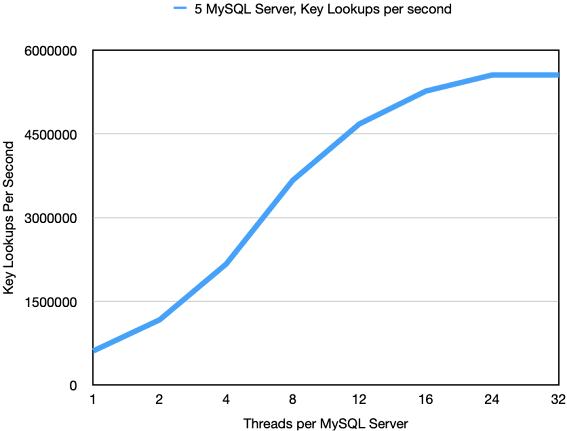
In the image above we see how the number of key value lookups grows extremely quickly, even with only 2 threads per MySQL Server we reach beyond 1M key lookups per second. The total throughput at 32 threads is 5.56M key lookups per second.


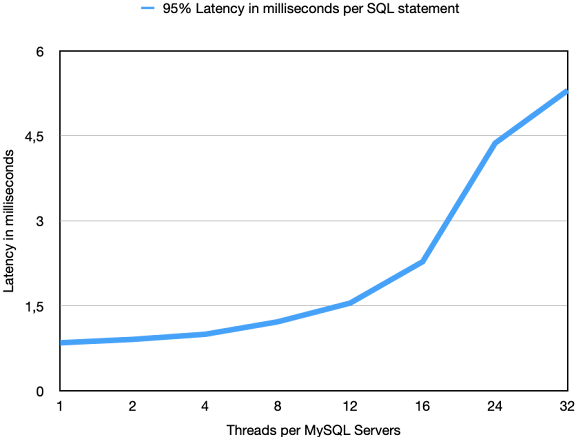
Even more interesting is the response time of each of those SELECT statements. Remember that each of those SELECT fetch 100 rows using a primary key lookup. Using 4 threads per MySQL Server we respond within 1.0 millisecond with a throughput of 2.17M key lookups per second. At 12 threads we deliver around 4.5M key lookups with a latency around 1.5 millisecond per SELECT query. At 16 threads we deliver 5.27M key lookups at a response time of 2.28 milliseconds.


Thus as can be seen from these numbers, even using SQL, RonDB can provide astonishing key lookup performance. Obviously using C++, Java or JavaScript key-value APIs we expect to perform a lot better yet and in particular it will use much less CPU on the client side.


Monday, May 10, 2021

Research on Thread Pipelines using RonDB


Introduction

In my previous two blogs on this topic I first introduced the concept of automatic thread configuration and the thread model we use in RonDB. After receiving some questions on the topic I dived a bit deeper into explaining the RonDB thread model and its thread pipeline and compared it to another similar concept called batch pipelines.


Since then I read up a bit more on the research in this area with a focus on implementations in other key-value stores. Some researchers argue that a model where one handles the request immediately is superior to a model using a thread pipeline.

RonDB Software Architecture

RonDB has its roots in MySQL NDB Cluster which was developed at Ericsson in the 1990s. The execution engine in NDB has always used asynchronous programming. NDB has its roots in AXE, a telecom switch that Ericsson developed in the 1970s and still develops actually. The development model in AXE used two concepts called blocks and signals. This architecture was inherited from using a HW architecture as base for the software architecture.


The idea is that the blocks are independent units that only communicate with other blocks using signals. This is the model that all hardware is built with due to physical constraints. The reasoning in AXE was that this model is beneficial also to develop large software systems. Development of blocks can be made independent of each other as long as they handle the signalling protocols correctly.


In the 1990s CPUs were single-threaded, sometimes you had 2 CPUs on the motherboard. So a single-threaded model was good enough. When moving to a multi-threaded environment it was necessary to find a way to break up the single-threaded model into a multi-threaded model. In NDB this used two approaches, the first approach was to simply divide the blocks into execution modules. These execution modules are true to the block concept, thus they only communicate with each other through asynchronous signals. Blocks within an execution module are allowed to communicate with synchronous signals and can for optimisation purposes use direct method calls.

RonDB execution modules


In NDB the execution modules are the following:

  1. Transaction Coordinator (tc)

  2. Local Data Manager (ldm)

  3. Main execution module (main)

  4. Replication module (rep)

  5. Network receive (recv)

  6. Network send (send)


These execution modules are now natural to divide into threads. Each execution module can potentially be an independent thread.


However to scale RonDB to larger systems it is also necessary to split a few of those execution modules. The tc module can easily be scaled by allowing each tc module to handle its own set of transactions. This makes for a simple round-robin model to select the tc module to handle a transaction.


The ldm module can be split by partitioning the data and let each ldm module handle a subset of the data. This makes for an easy way to route the data requests to the correct ldm module.


The network receive and the network send modules can be split by partitioning on sockets. Thus each receive socket is handled by one recv module and each send socket is handled by one send module. Each recv and send module can handle multiple sockets.


Actually the send module is handled a bit using its own model where other modules can either handle the send themselves or offload it to the send module. This is not the topic for this blog, so I won’t go into more details about send modules.


One problem with this design is that partitioning the data makes perfect sense for key-value lookups that access data using a primary key. However RonDB is a key-value database with SQL capabilities, thus it is important to also perform well for more complex queries even complex join queries accessing a multitude of tables.


In the partitioned model a range scan not using the partition key has to scan all partitions. This is both beneficial and inefficient. It allows for automatic parallelisation of the range scan, but the lookup in the index tree has to be done once in each partition which increases the cost of the range scan. The solution would be to have some amount of partitioning, but to limit it.

RonDB Query threads


To alleviate this problem a new execution module was invented which is used in RonDB. This is the query execution module. This is in reality the same module as the ldm module, but it is only allowed to handle Committed Read queries. Thus all locked reads and all writes are still routed to the ldm module.

Experiment setup

Now to the point of this description. As can be seen from the above description we have a set of execution modules where each execution module can be assigned to an independent thread. This thread can participate in the thread pipeline previously described and shown in the image above.


The important thing here is that we are actually at liberty to place the execution modules into threads in any manner we like. This opens up the floor to use RonDB as a vehicle to research the benefits and deficiencies of thread pipelines.


The code used in these experiments is found in the hopsworks_2525 branch in the RonDB tree.


In this branch of RonDB it is possible to colocate the tc threads and recv execution modules. Thus each recv thread has both a tc execution module as well as a recv execution module. The assignment of the tc execution module will always be done such that the recv execution module and the tc execution module is placed in the same recv thread.


This makes it possible to create a RonDB data node where we only have separate recv threads and ldm/query threads. However I took another step and even made it possible to run RonDB with only receive threads. In this case each recv thread contains a recv, tc, ldm, and query execution module. In this case we will always select the local query module to execute the query if possible.


The above model makes it possible to experiment with the various settings.


To test this I used a micro-benchmark using variants of the Sysbench test presented here and here. The tests were executed on a P620 Lenovo workstation with a AMD Threadripper processor based on the AMD Zen 2 architecture.


To analyze the tests and to try to understand the reasons for the performance differences in the setups I used a set of perf scripts that can be found in the dbt2 benchmark tree.


The setup I am going to report here used two different setups of RonDB. The setups are not using the automated thread configuration, but rather use the ThreadConfig configuration variable that makes it possible to set up a large variety of thread configurations and experiment with those. I will add the autobench.conf used in those benchmarks at the end of the blog.


The RonDB data nodes used 4 threads that were locked to 4 CPUs using 2 CPU cores in both experiments. One experiment used 4 receive threads that try to do all processing on one thread, the second experiment used 2 receive threads that handle both the receive execution module and the tc execution module and then 1 ldm thread and 1 query thread.


We will call the set up with separated ldm and recv threads the LDM setup and the other setup will be called the Receive setup in this document.

Key-value lookups

The first experiment uses a variant where Sysbench only performs batched primary key lookups with 100 lookups in each SQL statement.


In this case the model LDM setup is able to handle 1.34M lookups per second. The Receive setup is able to handle 1.05M lookups. Thus the thread pipeline achieves almost 30% better throughput in this experiment.


Given that both experiments are executed within RonDB using exactly the same code, from the same RonDB version, it is safe to assume that the execution uses the same amount of code, the same amount of instructions are executed to perform a key-value lookup.


So what differs when looking into the CPU statistics. What is clear is that modern CPUs are very hard to analyze given that they are extremely good at parallelising tasks. 


The two things that stand out are the IPC achieved, the CPU usage and the clock frequency used. The ldm thread in the LDM setup achieves an IPC of 1.40, a frequency of 3.96 GHz and 99.8% CPU usage. The query thread has an IPC of 1.30, a frequency of 3.95 GHz and a CPU usage of 99.9%. The receive threads in the LDM setup have an IPC of 1.26, a frequency of 3.886 and a CPU usage of 66.4%.


The Receive setup threads have an IPC of 1.05, a frequency of 3.468 GHz and a 77.6% CPU usage.


Thus the performance difference comes from a combination of a higher IPC in the LDM setup, but also actually it runs at 500MHz higher clock frequency. The total CPU usage is slightly higher in the LDM setup. Those factors combined account for the 30% difference.


So trying to understand those numbers one can see that the LDM setup has a higher hit rate in the L1 data cache and slightly higher hit rate in the L1 instruction cache. There is also a slightly higher branch prediction miss rate in the Receive setup. However nothing revolutionary is seen here. The L2 miss rate is very similar in both experiments. The other difference is that the Receive setup sees a 10x higher rate iTLB misses.


The only real difference between the two cases is that the Receive setup will see more code. Thus it is expected that it will have to pay for that with more instruction cache misses, but interestingly this also triggers changes in the CPU frequency.


Thus our conclusion here is that if one can achieve a setup where the thread uses a limited amount of code to achieve its purpose, the performance will be much higher.


In principle the conclusion I do is that if we can decrease the code size we touch in a thread, this will directly affect the performance.


Using some number crunching we see that executing one key-value lookup in the ldm thread uses about 6000-7000 x86  assembler instructions. Thus the payback of decreasing the code size is almost logarithmic. So reusing the same code gives great payback in throughput of your program.


To summarize executing about 10k instructions in a single thread costs almost 30% more than

splitting up the execution in 2 threads where one thread takes care of 4k instructions and the other takes care of 6k instructions.


It isn’t expected that this gain is independent of the code size. It is likely that when the code size fits well into the L1 instruction cache, that brings about a large performance enhancement. Thus if the code size of each of threads in the thread pipeline is too big for the L1 instruction cache, it is not expected that the gain of the thread pipeline is very large. So to optimize performance one needs to keep the code size aligned with the size of the instruction cache. This means that another important factor impacting the performance is the choice of compiler flags, this choice plays together with the software architecture.

Range Scans

The next test I singled out only included range scans from Sysbench. This had two effects, first the code executed was different, in the ldm/query thread this led to even higher IPC and even higher frequency of the CPU. The IPC increased to 2.25 and the frequency increased by 2%. However another effect was that a lot more of the processing moved to the ldm/query threads, thus the receive thread was much less involved. This had the effect that the Receive setup actually had higher throughput in this case.

Outcome of tests

What we have shown with those tests is that it is beneficial from an efficiency point of view to use a thread pipeline. It increases the IPC and surprisingly also increases the frequency the CPU core operates in. This can increase the throughput up to at least 30% and even more than that in some tests executed.


At the same time the workload can cause the load to be unbalanced, this can cause some CPUs to be a bit unused. This can cause up to 30-40% loss of performance in some workloads and no loss at all and even a small gain in other workloads.


Thus the outcome is that whether or not using a thread pipeline or not is dependent on the workload. We have concluded that thread pipelines definitely provide an advantage, but also that this advantage can be wiped out by imbalances in the load on the various threads in the pipeline.

Adaptive solution

So actually when I started this exercise I expected to find out which model would work best. I wasn’t really expecting to come up with a new model as the solution. However the results made it clear that thread pipelines should be used, but that one needs to find ways of using the free CPU cycles in the LDM setup.


Given the flexibility of the query threads we have an obvious candidate for this flexibility. It is possible to execute some queries directly from the receive threads instead of passing them on to the ldm/query threads. The introduction of query threads makes it possible to be more flexible in allocating the execution of those queries.


So the conclusion is that a combination of the Receive setup and the LDM setup is the winning concept. However this introduces a new technical challenge. It is necessary to implement an adaptive algorithm that decides when to execute queries locally in the receive thread and when to execute them using the ldm/query threads.


This is in line with the development of RonDB the last couple of years. The static solutions are rarely optimal, it is often necessary to introduce adaptive algorithms that use CPU load statistics and queue size statistics for the threads in the mix.


In a sense this could be viewed as a query optimizer for key-value databases. SQL queries are usually complex and require careful selection of the execution plan for a single query. In a key-value database millions of queries per second flow through the database and by adapting the execution model to the current workload we achieve query optimisation of large flows of small simple queries.


autobench.conf

#

# Software definition

#

USE_RONDB="no"

USE_BINARY_MYSQL_TARBALL="no"

TARBALL_DIR="/home/mikael/tarballs"

MYSQL_BIN_INSTALL_DIR="/home/mikael/mysql"

BENCHMARK_TO_RUN="sysbench"

MYSQL_VERSION="rondb-gpl-21.10.0"

DBT2_VERSION="dbt2-0.37.50.17"

SYSBENCH_VERSION="sysbench-0.4.12.17"

MYSQL_BASE="8.0"

TASKSET="numactl"

#

# Storage definition

#

DATA_DIR_BASE="/home/mikael/ndb"

#

# MySQL Server definition

#

SERVER_HOST="127.0.0.1"

SERVER_PORT="3316"

ENGINE="ndb"

MYSQL_USER="root"

#

# NDB node definitions

#

NDB_EXTRA_CONNECTIONS="32"

NDB_MULTI_CONNECTION="4"

NDB_TOTAL_MEMORY="25200M"

NDB_MGMD_NODES="127.0.0.1"

NDBD_NODES="127.0.0.1"

NDB_FRAGMENT_LOG_FILE_SIZE="1G"

NDB_NO_OF_FRAGMENT_LOG_FILES="16"

NDB_SPIN_METHOD="StaticSpinning"

NDB_MAX_NO_OF_CONCURRENT_OPERATIONS="262144"

NDB_AUTOMATIC_THREAD_CONFIG="no"

NDB_THREAD_CONFIG="ldm={count=1,cpubind=0},query={count=1,cpubind=1},tc={count=0,cpubind=2},recv={count=2,cpubind=32,33},send={count=0,cpubind=35},main={count=0,cpubind=36},io={count=1,cpubind=33}"

#NDB_THREAD_CONFIG="ldm={count=0,cpubind=0},query={count=0,cpubind=3},tc={count=0,cpubind=2},recv={count=4,cpubind=0,1,32,33},send={count=0,cpubind=35},main={count=0,cpubind=36},io={count=1,cpubind=33}"

#

# Benchmark definition

#

SYSBENCH_TEST="oltp_rw"

MAX_TIME="20000"

#SB_POINT_SELECTS="0"

SB_NUM_TABLES="1"

#SB_SUM_RANGES="0"

#SB_DISTINCT_RANGES="0"

#SB_ORDER_RANGES="0"

#SB_SIMPLE_RANGES="0"

#SB_USE_IN_STATEMENT="100"

THREAD_COUNTS_TO_RUN="48"

SERVER_BIND="0"

SERVER_CPUS="8-27,40-59"

BENCHMARK_BIND="0"

BENCHMARK_CPUS="28-31,60-63"